Sheet metal fabrication in Bangalore, from drawing to dispatch
Shabari Metal Products has been doing sheet metal fabrication in Bangalore since 2006, from a factory in Singapura, within the wider Abbigere locality. Cutting, punching, bending, welding, finishing, assembly and inspection all happen on one site, so a part is not handed between three subcontractors before it reaches you. Work runs from a single prototype to repeat production, on drawings or a sample part.
What end-to-end fabrication actually includes
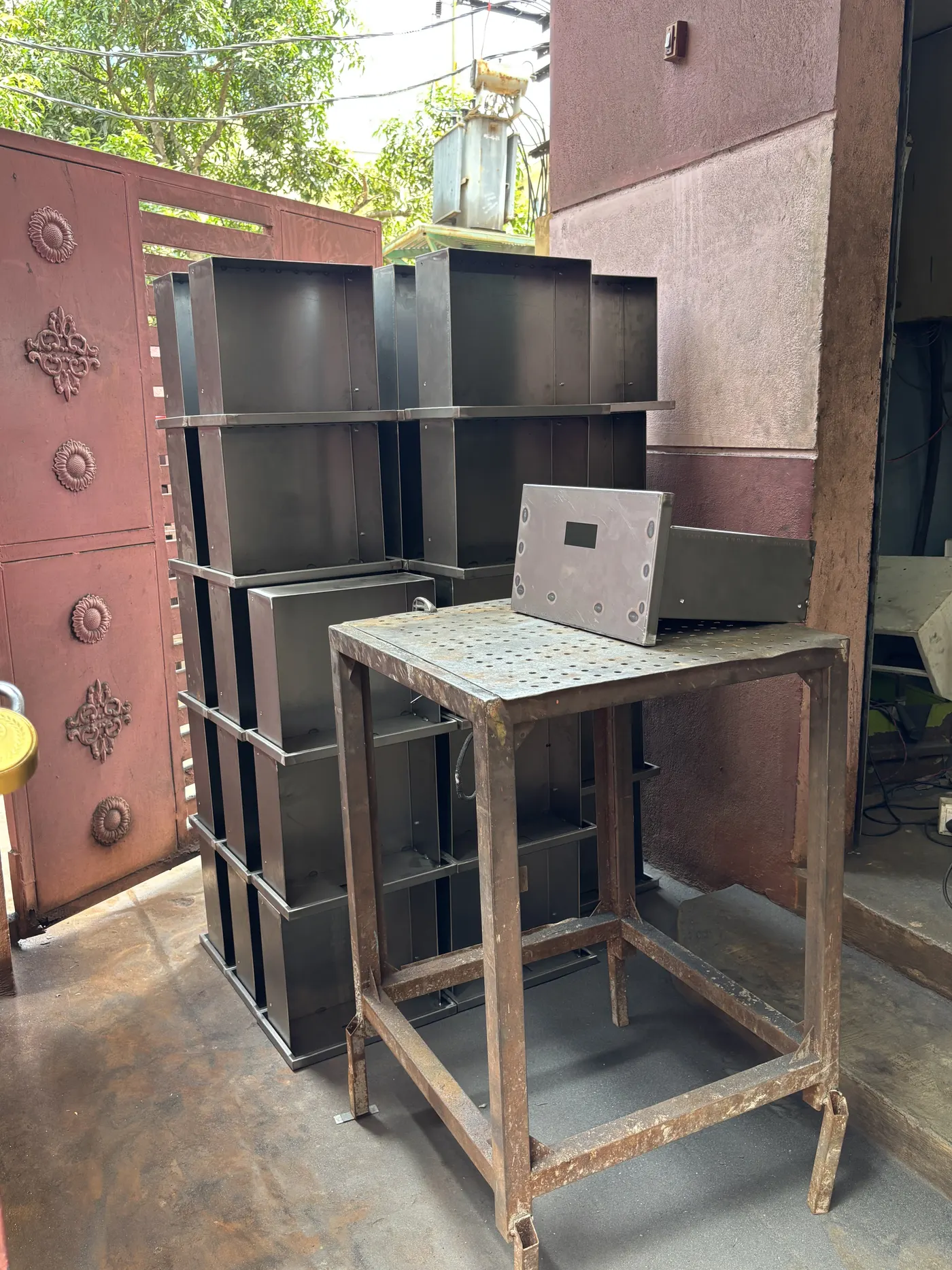
Fabrication is usually sold in pieces. One shop cuts, another bends, a third powder coats, and the buyer carries the risk when the parts meet and do not fit. We run the whole chain inside one factory: fiber laser cutting, CNC punching, CNC press brake bending, press work up to 500T, MIG, TIG, spot and laser welding, powder coating, zinc plating, brushed stainless finishing, a dedicated in-house assembly team and a separate in-house QC team. The part stays inside one factory from the DXF through to dispatch. That matters most on enclosures, where a small error at the cut stage compounds through forming and welding until a door will not close square. It also means the part is not moved between separate cutting, forming and finishing shops, each reading the drawing on its own.
- Fiber laser cutting holding ±0.1mm, with clean dross-free edges that need no secondary finishing before bending or welding
- CNC punching — ventilation slots, cable entries and mounting patterns punched in a single setup for repeatable hole positions
- CNC press brake bending, with repeatable bend angles and consistent radii held across long production runs
- MIG, TIG, spot and laser welding, with seams dressed so they survive finishing without rework
- Press work to 500T: blanking, deep drawing and custom forming
- Powder coating, zinc plating and brushed stainless finishing
- A dedicated in-house assembly team, and a separate QC team inspecting every batch before dispatch
From drawing to dispatch
The sequence is the same whether the order is one prototype or a repeat batch. Send a 2D or 3D file — DXF, DWG, STEP or PDF. If you only have a sketch or a sample part, we can work from that too and produce the drawing for you. Our engineering desk reviews drawings and responds within 24 business hours; bend sequence, tool access and whether features sit far enough from bend lines to survive forming are the usual points to settle before a price is fixed. On approval the part is nested and laser cut or punched, formed on the press brake, welded and dressed, deburred, then finished. A dedicated in-house assembly team builds up complete units rather than shipping loose panels, and a separate in-house QC team runs dimensional inspection on every batch before dispatch. Material can be supplied with mill test certificates on request.
Choosing between CRCA, GI, stainless and aluminium
General industry guidance, not a statement of this shop's measured performance. CRCA is the default for indoor enclosures: lowest cost, a smooth surface that takes powder coat well, and no corrosion resistance of its own, so it must be coated. Galvanised sheet resists corrosion without paint, but the zinc burns off at weld seams and coating adhesion over it needs specific pretreatment. SS 304 covers most clinical and wipe-down applications. SS 316 adds molybdenum and earns its higher cost only where chlorides are present — coastal air, saline, some chemical exposure. Aluminium is light and will not rust, but it is softer, springs back more in bending and wants larger bend radii. All of these are materials we handle; which one suits your drawing depends on the environment the part lives in.
- CRCA — indoor, painted, cost-driven work
- Hot-rolled mild steel — heavier structural parts, mill scale cleaned off before finishing
- GI — corrosion resistance without paint, awkward to weld
- SS 304 — general clinical, food and wipe-down surfaces
- SS 316 — chloride or coastal exposure only
- Aluminium — weight-critical parts, larger bend radii
- Copper sheet — specified for electrical conductivity rather than structural strength
Design details that decide what a part costs
General industry guidance again, not a claim about tolerances held here. A few drawing issues come up again and again in sheet metal work, and they are worth settling before a price is fixed. Keep the inside bend radius at least equal to material thickness on mild steel, and larger on aluminium, or the outer fibre cracks. Hole and slot edges want to sit at least twice material thickness from a bend line, or forming pulls them oval. Add bend relief at the ends of a partial bend — roughly one thickness wide and deeper than the bend radius — to stop tearing at the corner. Dimension from one datum instead of chaining features so tolerances do not stack, and mark only the dimensions that are genuinely critical. If the part has to keep dust or water out, design the seal path first: under IEC 60529 the first IP digit covers ingress of solids and the second water, and both depend on a continuous gasket groove rather than a coating. A formal IP rating comes only from testing the finished assembly to IEC 60529 at an accredited laboratory; it is not something a fabricator can assign on a drawing.
Laser or punch, powder coat or plating
General industry guidance, not a list of forms produced here. Laser cutting wins on varied contours, low volumes and tight tolerances because there is no tooling to make, and it leaves a cleaner edge on stainless. Turret punching wins when the same standard features repeat across many parts, and punch tooling can produce forms a laser cannot — louvres, dimples, extruded and tapped holes. Plenty of parts use both. On finishing, powder coat is a thick film that gives colour, texture and impact resistance, but it depends entirely on pretreatment: degrease, phosphate, and deburr first, because a burr holds thin coating and becomes the first point of edge corrosion. Zinc plating is a thin sacrificial layer, better suited to fasteners, threads and hidden brackets where a thick film would foul a tolerance, but it has poor UV life. Brushed stainless is the choice where no coating is wanted at all.
Sectors served, and what the shop makes
Customers come from electrical, electronics, medical, industrial equipment, automation and robotics, and commercial infrastructure. Parts in production include electrical distribution panel enclosures, formed and welded from 1.6–2mm CRCA; self-service kiosk metal frames for digital payment terminals; medical diagnostic console enclosures; stainless steel medical equipment cabinets in SS 304 with soft-close drawer runners and radiused corners; medical cabinet drawer assemblies; medical trolley enclosures; and clinical equipment housings. The minimum order is a single prototype, and prototype runs are quoted the same way as production orders, scaling from there to repeat high-volume contract manufacturing. We supply customers across Bengaluru, Karnataka and the rest of India, and produce export-quality work for overseas shipment. On credentials, plainly: MSME registered, ISO 9001 certification in progress and not complete. Quality is held by a separate in-house QC team inspecting every batch, not by a certificate.
- Files accepted: DXF, DWG, STEP, PDF, a sketch, or a physical sample part
- Quotation turnaround: within 24 business hours from the engineering desk
- Minimum order: one prototype, scaling to repeat high-volume contract manufacturing
- Registration: MSME registered, GSTIN 29BKEPS6457E1ZQ, ISO 9001 in progress
- Factory: No 197 & 196 Shabari, 1st Cross Road, Achappa Layout, Shrinketh Layout, Singapura, Bengaluru, Karnataka 560090
- Contact: +91 99453 80273 or +91 97424 04052, sales@shabarimetals.in, proprietor Sathish Kumar P
Common questions
What do you need to quote a sheet metal fabrication job?
Send a 2D or 3D file — DXF, DWG, STEP or PDF — with material, thickness, finish and quantity marked. If you only have a sketch or a sample part, we can work from that too and produce the drawing for you. The engineering desk at Shabari Metal Products reviews drawings and responds within 24 business hours from the Bengaluru factory.
Can I order a single prototype, or is there a minimum quantity?
The minimum order is one prototype, and prototype runs are quoted the same way as production orders. From there the same factory handles repeat high-volume contract manufacturing. Cutting, punching, bending, welding, finishing, assembly and inspection all happen on one site in Bengaluru, so prototype and repeat work stay under one roof instead of being split across separate subcontractors.
Should I specify CRCA, galvanised or stainless steel for an enclosure?
As general industry guidance: CRCA is cheapest and takes powder coat well but has no corrosion resistance uncoated, so it suits indoor painted enclosures. Galvanised sheet resists corrosion unpainted but complicates welding, since zinc burns off at the seam. SS 304 covers most clinical and wipe-down uses. SS 316 costs more and is justified only where chlorides are present, such as coastal or saline environments.
Is Shabari Metal Products ISO 9001 certified?
No. The company is MSME registered and ISO 9001 certification is currently in progress — it is not certified yet. Quality control is handled by a separate in-house QC team that carries out dimensional inspection on every batch before dispatch, and material can be supplied with mill test certificates on request. The business has operated in Bengaluru since 2006 under proprietor Sathish Kumar P.
Plan your fabrication order
Prepare the specifications that help us review your drawings and quote accurately.
Send us your drawing
Send a DXF, DWG, STEP or PDF — or a sample part if there is no drawing. Our engineering desk reviews drawings and responds within 24 business hours.