Press components and metal forming up to 500T
Shabari Metal Products runs press work at its Bengaluru factory: blanking, deep drawing and custom forming, with press capacity up to 500T. Press components sit alongside fiber laser cutting, CNC punching, press brake bending, welding, finishing and assembly under one roof, so a drawn shell can be blanked, formed, welded, coated and assembled without leaving the building.
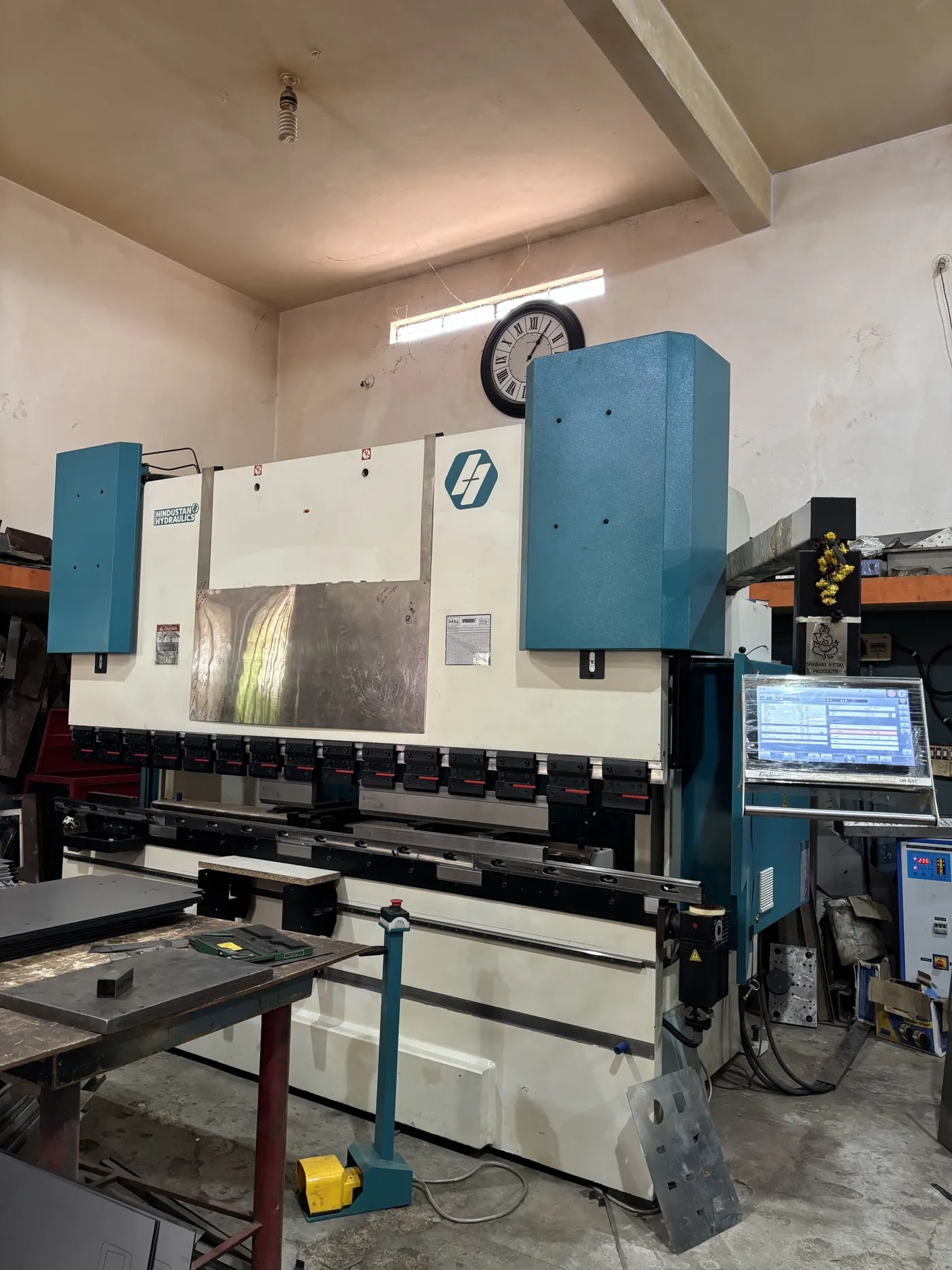
Press components and metal forming we produce in house
Press work here covers three things. Blanking produces a flat profile in a single press stroke, so the outline and any cut-outs land together and every part in the run shares one geometry rather than one traced path per part. Deep drawing pulls a flat blank into a closed shell: a cup, a tray, a housing with no corner seams to weld or seal. Custom forming covers the rest, putting stiffness or a feature into a panel that a press brake cannot fold. Which forming operations a part actually needs is settled against your drawing at quotation stage rather than assumed from a menu. Pressed parts then move to the same welding, coating and assembly lines as our laser-cut and bent work, so a pressed component and the parts it bolts to go through the same in-house finishing and inspection.
- Blanking to produce a flat profile in a single press stroke
- Deep drawing of cups, shells, trays and closed housings
- Custom forming for stiffness and features a press brake cannot fold, confirmed per drawing
- Press work up to 500T
- Welding, powder coating, zinc plating, assembly and QC inspection in the same factory
When pressing beats laser cutting and bending
What follows is general process economics, not a statement about any particular part. The answer turns on volume and geometry, not on which process sounds more advanced. Laser cutting plus press brake bending carries no tooling cost. You send a DXF, you get parts. That suits prototypes, low volumes, and anything whose geometry is still moving. Pressing carries a tooling cost up front and pays it back in cycle: once a die exists the part is defined by the die rather than by an operator's bend sequence, and the per-part cycle is dominated by the press stroke rather than separate cutting and folding steps. Geometry can force the decision on its own. A drawn shell, seamless with radiused corners and no weld line, cannot be made on a brake at all. Embossed ribs, formed louvres, countersinks and coined flatness are likewise press features. If a part needs any of those, the tooling conversation starts regardless of quantity.
What press tooling commits you to
A die is a capital item with a design freeze attached. Before it is cut, agree the part geometry, the material grade and thickness, and the finish. A die built for one thickness does not simply run another, and a corner-radius change after tryout is rework on hardened steel, not a CAD edit. The sequence that saves money is straightforward: prove the design with laser-cut and bent prototypes, fit them into the real assembly, sign the drawing, then commit tooling. Prototype runs are quoted the same way as production orders here, so proving a design first does not put you into a different commercial track. Settle the unglamorous items in writing at quotation stage: who owns the tool, where it is stored, who pays for maintenance and replacement, and how many parts it should run before refurbishment. Ask for tooling to be itemised separately from the piece price.
How repeat volume changes the unit price
As general press economics, the delivered cost of a pressed part is the piece cost plus the tooling cost divided by the quantity you actually order. The second term is what moves. Spread a die across a few hundred parts and it dominates the number; spread it across repeat call-offs and it approaches zero, leaving a piece cost normally lower than the fabricated equivalent. Two levers matter more than most buyers expect. Layout is the first: how tightly blanks nest on the material sets utilisation, and on a high-volume part scrap can outweigh everything else. Tell us the expected annual quantity early so a nesting change is designed in rather than discovered. Secondary operations are the second. A pierced hole, a formed tab or a countersink built into the die costs nothing extra at production rate; added afterwards it is a separate handling operation on every part.
Design guidance for drawn and formed parts (general industry practice)
The paragraph below is general industry guidance, not a statement of what this or any other shop can hold. Confirm every figure against your own drawing and material. A first draw is commonly held to roughly a 1.8 to 2.0 ratio of blank diameter to punch diameter; deeper shells need redraw stages, and every stage is more tooling. Material choice drives that limit. SS 304 and SS 316 work-harden quickly, so heavy draws in stainless may need interstage annealing, while deep-drawing grades of CRCA and most aluminium alloys form more readily. Galvanised sheet can gall or shed its zinc layer under a severe draw, which suits it to shallow forming rather than deep shells. Generous punch and die radii cut thinning and tearing, and sharp internal corners in a drawn box are where splits start.
- Keep pierced holes clear of a formed edge; two material thicknesses is a common rule of thumb
- Pierce after forming if the hole falls inside the deformation zone
- Add bend relief at the ends of a flange to stop tearing
- Dimension from a single datum, and call out only the dimensions that are actually critical
- Deburr before powder coating, because a burr shows through the coat
Materials, inspection and getting a quotation
We work in cold-rolled CRCA, hot-rolled mild steel, galvanised GI sheet, stainless SS 304 and SS 316, aluminium alloys and copper sheet, with mill test certificates available on request. Whether a grade and thickness suits a particular press operation is confirmed against your drawing at quotation stage. Pressed parts run the same downstream lines as the rest of our work: MIG, TIG, spot and laser welding, powder coating, zinc plating and brushed stainless finishing. A dedicated in-house assembly team builds up complete units rather than shipping loose panels, and a separate in-house QC team runs dimensional inspection on every batch before dispatch. Send DXF, DWG, STEP or PDF. If you only have a sketch or a sample part, we can work from that and produce the drawing for you. Our engineering desk reviews drawings and responds within 24 business hours. Shabari Metal Products has fabricated sheet metal in Bengaluru since 2006, is MSME registered, and has ISO 9001 certification in progress rather than held.
- Files accepted: DXF, DWG, STEP, PDF, or a sketch or sample part we produce the drawing from
- Volume: single prototypes through to repeat high-volume contract manufacturing, prototypes quoted the same way as production orders
- Quotation response: within 24 business hours from our engineering desk
- Factory: No 197 & 196 Shabari, 1st Cross Road, Achappa Layout, Shrinketh Layout, Singapura, Bengaluru, Karnataka 560090 (Singapura sits within the wider Abbigere locality)
- Phone +91 99453 80273 or +91 97424 04052, email sales@shabarimetals.in, GSTIN 29BKEPS6457E1ZQ
- Customers across Bengaluru, Karnataka and the rest of India, plus export-quality work for overseas shipment
Common questions
What press capacity does Shabari Metal Products have?
Press work runs up to 500T at our Bengaluru factory, covering blanking, deep drawing and custom forming. Pressed parts are welded, powder coated or plated and assembled in the same facility, alongside fiber laser cutting, CNC punching and press brake bending. Send a drawing with the material grade and expected quantity and our engineering desk will confirm whether the part suits pressing, responding within 24 business hours.
Is pressing cheaper than laser cutting and bending?
It depends on volume and geometry. Laser cutting plus press brake bending carries no tooling cost, so it usually wins for prototypes, low volumes and designs that are still changing. Pressing needs a die up front, but the part is then defined by the die rather than by an operator, so unit cost falls as quantity rises. Drawn shells, embossed ribs and formed louvres can only be pressed, which settles the question regardless of volume.
What should I settle before committing to press tooling?
Freeze the part geometry, the material grade and thickness, and the finish, because a die is cut for one specification and changes to hardened steel are expensive. Prove the design with laser-cut and bent prototypes and fit them into the real assembly first; prototype runs are quoted the same way as production orders. Also agree in writing who owns the tool, where it is stored, who maintains it, and that tooling is itemised separately from the piece price.
Which materials do you work with for pressed parts?
We work in cold-rolled CRCA, hot-rolled mild steel, galvanised GI sheet, stainless SS 304 and SS 316, aluminium alloys and copper sheet, with mill test certificates available on request. Suitability of a given grade and thickness for a given press operation is confirmed against your drawing at quotation stage. As general industry guidance, stainless work-hardens so heavy draws may need interstage annealing, and galvanised sheet suits shallow forming better than deep shells because the zinc layer can gall.
Plan your fabrication order
Prepare the specifications that help us review your drawings and quote accurately.
Send us your drawing
Send a DXF, DWG, STEP or PDF — or a sample part if there is no drawing. Our engineering desk reviews drawings and responds within 24 business hours.