Kiosk frame manufacturer for self-service and payment terminals
Shabari Metal Products has fabricated sheet metal enclosures in Bengaluru since 2006, and self-service kiosk frames for digital payment terminals are one of the product lines we build. As a kiosk frame manufacturer we cut, form, weld, finish and assemble the complete chassis inside one factory - payment terminal frames, information kiosks and free-standing self-service units, built up in house rather than shipped as loose panels.
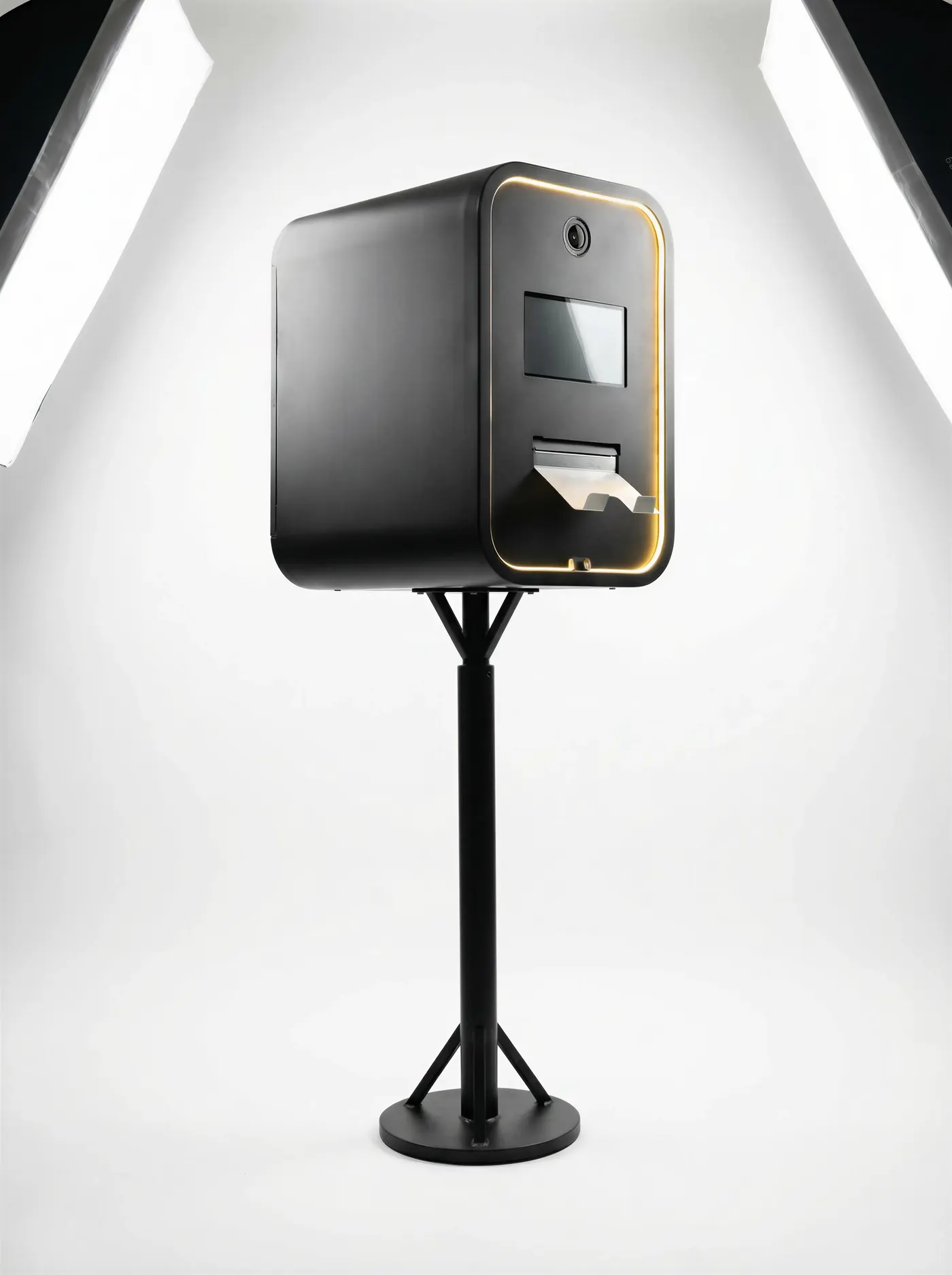
Kiosk chassis, payment terminal frames and information stands
A kiosk frame is a structural job before it is a cosmetic one. The chassis carries a display, a card reader or payment terminal, a printer, a PC or single-board computer, a power supply and often a note or coin unit, all of it hung off sheet metal that has to stay square while people lean on it. We build these as folded and welded frames. Profiles and panels are fiber laser cut, holding ±0.1mm with clean dross-free edges that need no secondary finishing before bending or welding, then formed on CNC press brakes that hold repeatable bend angles and consistent radii across long production runs. Joints are made with MIG, TIG, spot or laser welding depending on the seam, and seams are dressed so they survive finishing without rework. A dedicated in-house assembly team then builds the unit up, frame, doors, brackets, fasteners and latches, rather than shipping loose panels, and a separate in-house QC team runs dimensional inspection on every batch before dispatch. Single prototypes through to repeat high-volume contract manufacturing are quoted the same way.
Cable routing, rear service access and floor mounting
Three details decide how well a kiosk holds up in service, and all three are cheaper to fix on the drawing than on site. Cable routing wants a defined path: punched entries in the base, internal division plates, grommets at every sheet edge a cable crosses, and fixed tie-off points so the loom never rests on a cut edge. Service access wants a rear door or removable back panel a technician can open one-handed from behind the machine, with captive fasteners and hinges positioned so the door cannot foul a wall. Floor mounting wants slotted anchor holes in the base plate, so a fixed bolt pattern still aligns to an imperfect slab.
- Ventilation slots, cable entries and mounting patterns CNC punched in a single setup, for repeatable hole positions batch to batch
- Grommeted or bushed edges wherever a loom crosses sheet metal
- Rear access door or lift-off panel using captive fasteners
- Slotted base-plate holes to absorb floor-anchor position error
- Powder coating, zinc plating and brushed stainless finishing done in house, over deburred edges
Choosing material and finish for a kiosk that lives indoors or out
This is general industry guidance rather than a recommendation for your specific unit. For an indoor kiosk, cold-rolled CRCA is the usual default: it forms and welds cleanly, takes powder coat well and is normally the lowest-cost of the common options. Galvanised GI resists corrosion better, but every laser-cut or punched edge exposes bare steel, so it suits hidden structure more than visible skins. SS 304 earns its premium on high-touch surfaces and outdoor or wash-down units. SS 316 adds roughly two to three percent molybdenum over 304, which is worth paying for where chlorides are genuinely present and overspecified almost everywhere else. Aluminium saves weight but is less forgiving to weld cosmetically. Powder coating is the durable choice for visible panels; zinc plating suits internal brackets where a thick coating would interfere with fit. Deburr before coating either way: powder thins over a sharp edge, and that is where corrosion starts. We fabricate in CRCA, hot-rolled mild steel, GI, SS 304, SS 316, aluminium alloys and copper sheet.
Design notes that keep a kiosk frame cheap to fabricate
More generic guidance, worth checking your model against before quotation. Keep an inside bend radius roughly equal to material thickness for mild steel; tighter radii sometimes work but risk cracking, and aluminium alloys usually need more. Hold holes and slots at least two and a half times material thickness clear of a bend line, or the bend pulls the hole out of round. Add bend relief notches at the ends of partial bends so the metal does not tear. Dimension from a single datum face rather than chaining features across the part; chained dimensions stack tolerance, and a kiosk built from four chained panels is exactly where door gaps go wrong. On process choice, laser cutting usually beats turret punching where hole geometry varies, because there is no tooling to buy, while punching still wins on repeated standard holes and can form louvres a laser cannot.
Sealing details and what an IP rating actually means
Background rather than a claim about our output. IP codes under IEC 60529 use two digits, the first for solid objects and dust, the second for water, so IP54 reads as dust-protected and splash-resistant and IP65 as dust-tight and protected against water jets. The rating belongs to the finished, populated enclosure rather than to any one fabrication step, and a formal rating requires testing at an accredited laboratory, not something a fabricator assigns on a drawing. What is drawable is the construction that supports a sealing target: a gasketed door return with a continuous unbroken gasket run, a drip lip over display and card-reader openings, cable entries sized for rated glands rather than open holes, and drain paths that do not double as ingress paths. Put those details on the drawing and they are fabricated and priced as specified.
What to ask a kiosk frame manufacturer before you order
Ask which steps happen under the vendor's own roof. A frame cut in one shop, bent in another and coated in a third passes through more handling and more handover points, and responsibility for the finish gets diffuse. At Shabari Metal Products, fiber laser cutting, CNC punching, press brake bending, press work to 500T, MIG, TIG, spot and laser welding, powder coating, zinc plating, assembly and QC are all in house. Ask about paperwork too. We are MSME registered; ISO 9001 certification is in progress and we are not certified yet. Mill test certificates for the material are available on request. Send the job as DXF, DWG, STEP or PDF. If you only have a sketch or a sample part, we can work from that and produce the drawing for you. Our engineering desk reviews drawings and responds within 24 business hours.
Common questions
Do you manufacture kiosk frames for outdoor installation?
We fabricate in CRCA, GI, SS 304, SS 316 and aluminium and build to whatever the drawing specifies, including gasketed door returns, drip lips over openings and cable entries sized for rated glands. Outdoor units are normally specified in stainless or galvanised steel rather than plain CRCA. A formal IP rating comes from IEC 60529 testing at an accredited lab rather than from fabrication, so send us the sealing detail you want and it is priced in from the start.
What is the minimum order for a kiosk frame?
A single prototype. We handle single prototypes through to repeat high-volume contract manufacturing, and prototype runs are quoted the same way as production orders, so the same drawing can later run as a repeat batch without being requoted on a different basis. Send DXF, DWG, STEP or PDF files, or a sketch or a sample part if you have no CAD. Our engineering desk reviews drawings and responds within 24 business hours.
How is cable routing concealed inside a kiosk chassis?
Ventilation slots, cable entries and mounting patterns are CNC punched in a single setup, which gives repeatable hole positions from batch to batch. Internal division plates and brackets give the loom a defined path and fixed tie-off points, and every sheet edge a cable crosses gets a grommet or bush. Mark the cable paths on the drawing rather than leaving them to the shop floor, because routing decided at assembly rarely repeats identically.
Where are your kiosk frames manufactured?
At our factory at No 197 & 196 Shabari, 1st Cross Road, Achappa Layout, Shrinketh Layout, Singapura, Bengaluru, Karnataka 560090, within the wider Abbigere locality. Cutting, forming, welding, finishing and assembly all happen on that one site. We supply customers across Bengaluru, Karnataka and the rest of India, and produce export-quality work for overseas shipment. Call +91 99453 80273 or email sales@shabarimetals.in to discuss a requirement.
Plan your fabrication order
Prepare the specifications that help us review your drawings and quote accurately.
Send us your drawing
Send a DXF, DWG, STEP or PDF — or a sample part if there is no drawing. Our engineering desk reviews drawings and responds within 24 business hours.