CNC sheet metal fabrication in Bangalore, from cut file to finished part
Shabari Metal Products runs CNC fiber laser cutting, CNC punching and CNC press brake bending at one factory in Singapura, within the wider Abbigere locality of north Bengaluru, and has fabricated sheet metal in the city since 2006. This page explains what CNC means across that chain, why its repeatability matters on repeat orders and assemblies, and how to send a part for quotation.
What CNC means in sheet metal fabrication
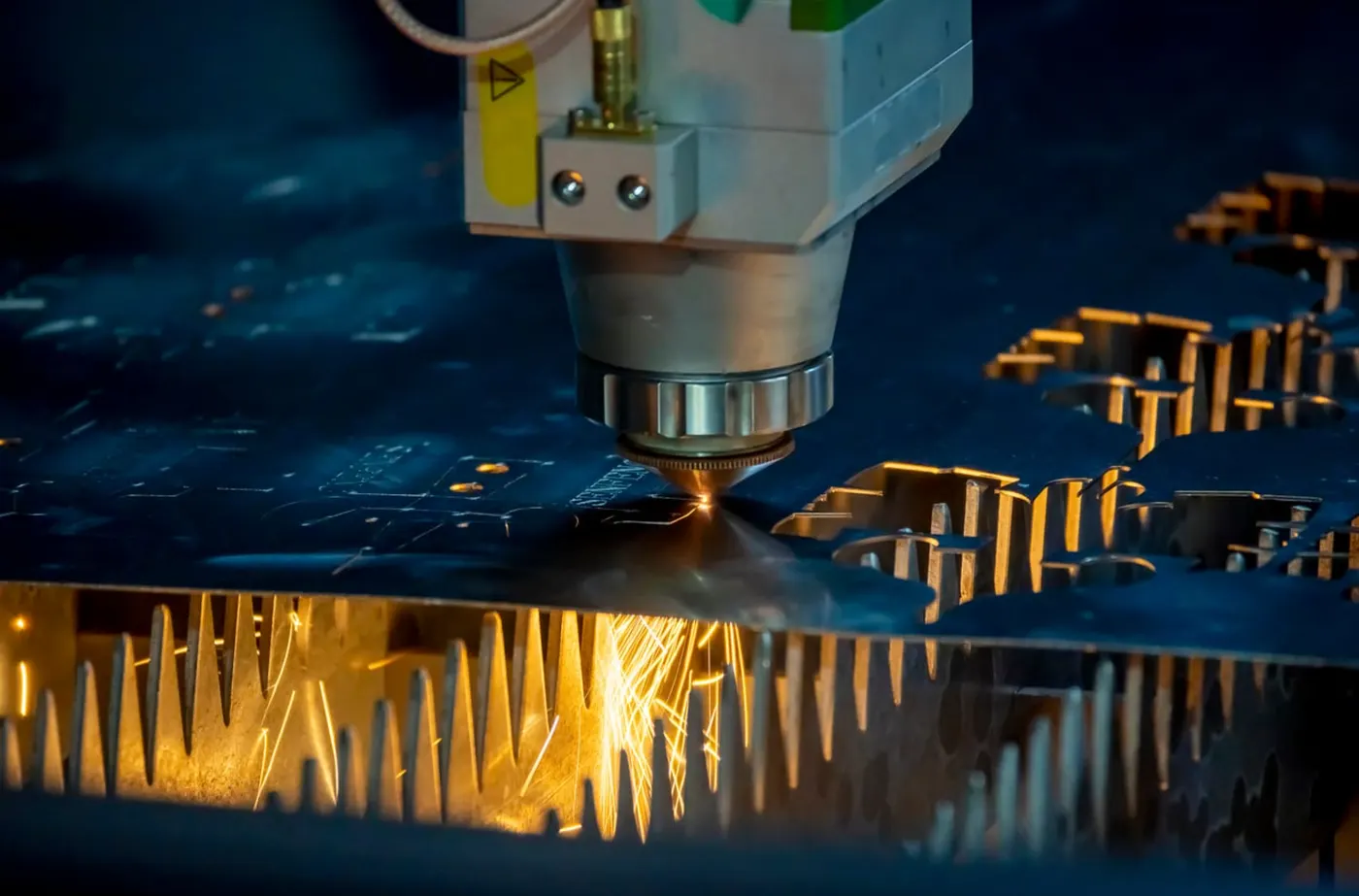
This section is general engineering background, not a claim about any one shop. CNC stands for computer numerical control: the machine executes a program generated from the CAD file rather than following an operator's manual layout. In sheet metal the term covers three different machines doing three different jobs. A CNC laser cutter drives a cutting head along a programmed path to produce the flat profile, holes and cut-outs in one pass. A CNC punch press positions the sheet under the tooling so repeated features land in programmed positions rather than marked-out ones. A CNC press brake controls ram depth and backgauge position, so bend angle and flange length come from the program instead of trial bends. The practical consequence is the same in all three cases: the part is defined by a file, and a file can be run again, unchanged, months later.
The CNC processes run in house at the Bengaluru factory
Three CNC operations run inside the one factory. Fiber laser cutting on a CNC machine holds ±0.1mm on cut features and leaves clean dross-free edges that need no secondary finishing before bending or welding; the ±0.1mm figure describes laser cutting only, not the operations after it. CNC punching produces ventilation slots, cable entries and mounting patterns in a single setup, for repeatable hole positions. CNC press brake bending holds repeatable bend angles and consistent radii across long production runs. Around those sit the operations a finished part still needs: press work up to 500T for blanking, deep drawing and custom forming; MIG, TIG, spot and laser welding, with seams dressed so they survive finishing without rework; powder coating, zinc plating and brushed stainless finishing; a dedicated in-house assembly team that builds up complete units rather than shipping loose panels; and a separate in-house QC team running dimensional inspection on every batch before dispatch.
- CNC fiber laser cutting: ±0.1mm on cut features, with clean dross-free edges — a figure that applies to laser cutting only
- CNC punching: ventilation slots, cable entries and mounting patterns in a single setup, for repeatable hole positions
- CNC press brake bending: repeatable bend angles and consistent radii held across long production runs
- In support: press work to 500T, MIG/TIG/spot/laser welding, finishing, in-house assembly and batch inspection
Why CNC repeatability matters for repeat orders and assemblies
On a one-off part, CNC mostly buys accuracy. On repeat work it buys sameness, which is usually worth more. Because the geometry lives in a program rather than in an operator's setup, a later batch is cut, punched and folded to the same numbers as the first, and a replacement panel ordered months after the original still fits the unit it was drawn for. Assemblies feel this most. An enclosure is several parts meeting at hole patterns and bend lines; when mounting patterns are punched in a single setup and bend angles repeat across the run, doors close square and bolted joints line up without drilling on site. Repeatability is still checked rather than assumed here: a separate in-house QC team runs dimensional inspection on every batch before dispatch, and material can be supplied with mill test certificates on request.
Choosing between laser cutting, CNC punching and press brake bending
As general process guidance rather than a menu specific to this factory: the three CNC operations do different jobs, and many parts pass through more than one. Laser cutting suits contoured outlines, low volumes and geometry that is still changing, because there is no tooling to make and a revision is only a new file. Punching suits the same standard feature repeated many times — vents, cable entries, mounting patterns — and punch tooling can form features a laser cannot, such as louvres and dimples, subject to the tooling a given shop holds. Press brake bending is how the flat blank becomes a folded part, and on a CNC brake the angle and flange length are programmed rather than set by eye. Where volume justifies a die, press work — blanking, deep drawing, custom forming — takes over from cut-and-fold; that trade-off is covered on our press components page.
Files, quotations and order sizes
Send DXF, DWG, STEP or PDF. If you only have a sketch or a sample part, we can work from that too and produce the drawing for you. Our engineering desk reviews drawings and responds within 24 business hours; that figure covers the quotation response, not production time, which is agreed order by order. The minimum order is one prototype, and prototype runs are quoted the same way as production orders, so a design proven as a one-off moves to repeat batches without changing commercial track. Materials worked in house are CRCA, hot-rolled mild steel, GI, SS 304, SS 316, aluminium alloys and copper sheet, with mill test certificates available on request. Customers come from the electrical, electronics, medical, industrial equipment, automation and robotics, and commercial infrastructure sectors.
- Files accepted: DXF, DWG, STEP, PDF, a sketch, or a physical sample part
- Quotation response: within 24 business hours from the engineering desk
- Minimum order: one prototype, scaling to repeat high-volume contract manufacturing
- Materials: CRCA, hot-rolled mild steel, GI, SS 304, SS 316, aluminium alloys, copper sheet
A north Bengaluru factory supplying Bengaluru, Karnataka and India
Bengaluru's sheet metal trade clusters around industrial belts like Peenya, Bommasandra, Jigani and Nelamangala — a fact about the city, not a claim about us. Our own factory is in Singapura, within the wider Abbigere locality of north Bengaluru, near the Peenya industrial belt; the business began at a Jalahalli facility in 2006 and moved to the current site, which is the only facility we operate. From it we supply customers across Bengaluru, including the Peenya and Nelamangala–Dabaspet industrial belts, across Karnataka and the rest of India, and produce export-quality work for overseas shipment. Stated plainly: MSME registered, ISO 9001 certification in progress and not yet held, proprietor Sathish Kumar P.
- Factory: No 197 & 196 Shabari, 1st Cross Road, Achappa Layout, Shrinketh Layout, Singapura, Bengaluru, Karnataka 560090
- Phone +91 99453 80273 or +91 97424 04052, email sales@shabarimetals.in
- Registration: MSME registered, GSTIN 29BKEPS6457E1ZQ, ISO 9001 in progress
- Supplied areas include Peenya, Yeshwanthpur, Nelamangala, Dabaspet, Doddaballapur, Bommasandra and Jigani — delivery areas, not branch locations
Common questions
What does CNC mean in sheet metal fabrication?
CNC stands for computer numerical control: the machine runs a program generated from the CAD file instead of relying on manual setup. In sheet metal it covers three machines — CNC laser cutters that cut the flat profile, CNC punch presses that place repeated features in programmed positions, and CNC press brakes that control bend angle and flange length. Shabari Metal Products in Bengaluru runs all three in house: fiber laser cutting, CNC punching and CNC press brake bending.
Do you offer CNC laser cutting in Bangalore?
Yes. Shabari Metal Products runs fiber laser cutting on a CNC machine at its factory in Singapura, north Bengaluru, holding ±0.1mm on cut features with clean dross-free edges that need no secondary finishing before bending or welding. Cut parts can carry straight on to CNC punching, press brake bending, welding, finishing and assembly under the same roof. Send DXF, DWG, STEP or PDF to sales@shabarimetals.in, or call +91 99453 80273.
How do I get a quotation from a CNC sheet metal manufacturer?
Send the part as DXF, DWG, STEP or PDF with material grade, thickness, finish and quantity stated. If you only have a sketch or a sample part, Shabari Metal Products can work from that too and produce the drawing for you. The engineering desk reviews drawings and responds within 24 business hours. The minimum order is one prototype, and prototype runs are quoted the same way as production orders.
Why does CNC matter for repeat sheet metal orders?
Because the part geometry lives in a program rather than in an operator's setup, later batches repeat the first. On CNC punching, ventilation slots, cable entries and mounting patterns are produced in a single setup, so hole positions repeat batch to batch; on a CNC press brake, bend angles and radii stay consistent across long production runs. At Shabari Metal Products a separate in-house QC team also runs dimensional inspection on every batch before dispatch, so repeatability is measured rather than assumed.
Do you supply CNC sheet metal parts to Peenya and Nelamangala?
Yes. All fabrication runs at one factory in Singapura, within the Abbigere locality of north Bengaluru, near the Peenya industrial belt. Shabari Metal Products supplies customers across Bengaluru — including the Peenya, Yeshwanthpur, Nelamangala, Dabaspet, Bommasandra and Jigani industrial areas — as well as the rest of Karnataka and India, and produces export-quality work for overseas shipment. Those are delivery areas: there is no branch or second facility outside the Bengaluru factory.
Plan your fabrication order
Prepare the specifications that help us review your drawings and quote accurately.
Send us your drawing
Send a DXF, DWG, STEP or PDF — or a sample part if there is no drawing. Our engineering desk reviews drawings and responds within 24 business hours.